
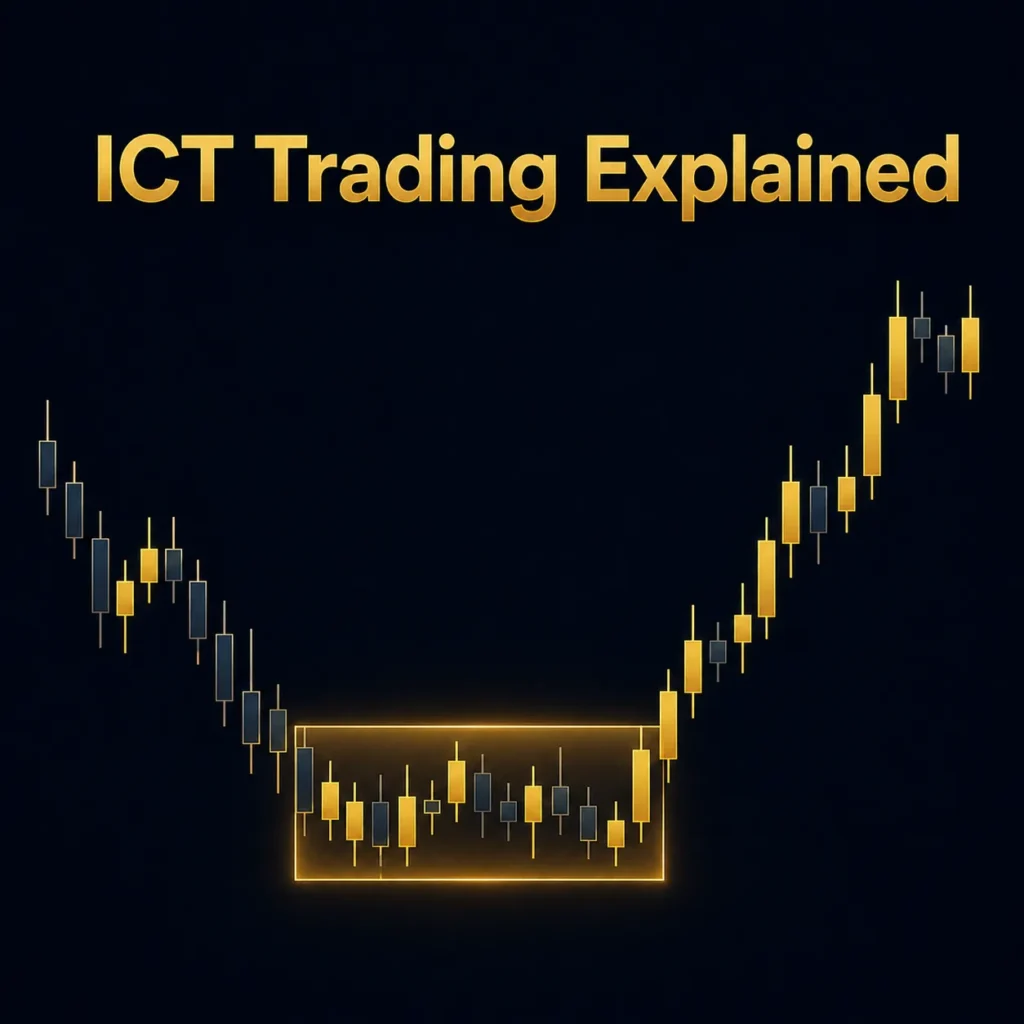
Key Takeaways: ICT (Inner Circle Trader) is a trading methodology that reads price action through institutional order flow rather than lagging indicators, using concepts like market structure, liquidity, order blocks, and fair value gaps. It’s especially popular for XAU/USD and major forex pairs because these markets are heavily driven by institutional participation. Like any framework, it requires disciplined risk management and practice — it is not a guarantee of profit.
If you’ve spent any time around forex or gold trading communities, you’ve likely come across the term ICT. It stands for Inner Circle Trader, a methodology popularised by trader Michael J. Huddleston, and it has become one of the most widely discussed approaches to reading price action in retail trading circles.
This article breaks down what ICT actually means, the core ideas behind it, and why so many traders — including our students in the Master ICT Course — use it as a framework for reading Forex and XAU/USD (gold) charts.
The Core Idea Behind ICT
Most retail technical analysis is built around lagging indicators: moving averages, RSI, MACD, and similar tools that summarise past price action. ICT concepts take a different starting point. The methodology assumes that price is largely driven by the order flow of large institutional participants — banks, funds, and liquidity providers — rather than retail indicator signals.
Instead of asking “what is the indicator telling me?”, an ICT trader asks “where is liquidity resting, and how might larger participants use that liquidity to move price?” That shift in framing is the foundation for every other concept in the methodology.
Key ICT Concepts You’ll Encounter
Market Structure
Market structure is the sequence of highs and lows that defines a trend. ICT traders pay close attention to structural shifts — a break of a recent swing high or low that signals a potential change in direction — as a primary trigger for analysis, rather than a lagging moving-average crossover.
Liquidity
“Liquidity” in ICT terms usually refers to clusters of resting stop-loss and pending orders — often just beyond obvious swing highs and lows, where retail traders commonly place stops. The idea is that price is frequently drawn toward these areas before reversing, because that’s where the volume needed to fill large institutional orders tends to sit.
Order Blocks
An order block is a candle or small cluster of candles that precedes a strong, decisive move in price. ICT traders treat these zones as a footprint of where institutional positioning may have originated, and often watch for price to return to that zone before continuing in the original direction.
Fair Value Gaps (FVGs)
A fair value gap is an imbalance left on the chart when price moves quickly in one direction, leaving a visible gap between candle wicks. ICT theory treats these gaps as areas price is statistically likely to revisit before continuing its broader move.
Killzones
Killzones are specific windows of the trading day — typically tied to the London and New York session opens — when ICT traders expect higher-probability volatility and directional moves, driven by increased institutional participation.
Why ICT Is Popular for XAU/USD and Forex
Gold (XAU/USD) and major forex pairs are heavily traded by institutional desks around the clock, which is exactly the kind of order-flow-driven environment ICT concepts are designed to read. That’s part of why the framework has found a strong following among traders focused on gold and the majors specifically, rather than lower-liquidity or highly retail-dominated markets.
An Important Caveat
ICT concepts are a way of framing price action — they are not a guarantee of outcome. Like any trading methodology, they require practice, backtesting, and disciplined risk management to apply consistently. Trading forex, gold, and CFDs carries significant risk, and no analytical framework removes that risk. Past performance and back-tested setups are not a reliable indicator of future results. See our Risk Disclaimer for more detail.
Where to Learn ICT Concepts Properly
Reading about ICT concepts is a reasonable starting point, but applying them consistently takes structured practice. If you’re new to trading altogether, our Forex Trading Elite Course builds the market-structure and risk-management foundation first. If you already understand the basics and want to go deeper into liquidity, order blocks, and institutional structure specifically, that’s exactly what the Master ICT Course covers in detail.