
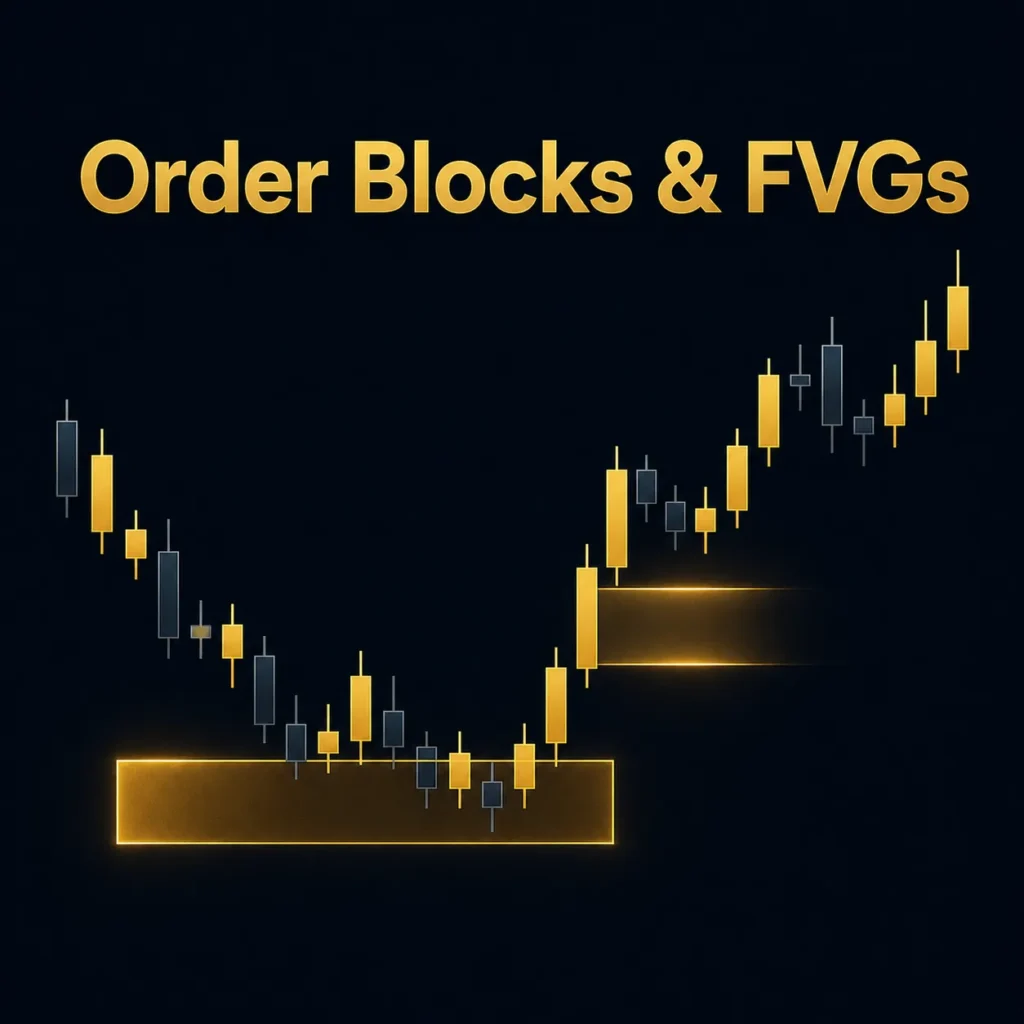
Key Takeaways: An order block is the last opposing candle before a strong directional move, treated as a footprint of institutional positioning. A fair value gap is a three-candle imbalance left when price moves too fast for two-sided trading to occur, which the market tends to revisit. The two are often used together — a zone with both is treated as higher-confidence than either alone.
Two of the most frequently referenced ICT concepts are order blocks and fair value gaps. Both are chart patterns believed to mark where institutional order flow left a visible imprint — and both are used as areas of interest for potential entries. This article explains what each one is, how they differ, and how they’re typically used together.
What Is an Order Block?
An order block is the last opposing candle (or small cluster of candles) before a strong, decisive move in the opposite direction. In an uptrend, a bullish order block is typically the last down-close candle before an aggressive rally; in a downtrend, a bearish order block is the last up-close candle before a sharp decline.
The logic behind order blocks is that a strong, fast move usually requires substantial buying or selling interest, and that interest often originates from a relatively tight price zone — the order block — where large positioning began. Traders watch for price to return to that zone later, treating it as an area where the same interest may re-emerge.
What Is a Fair Value Gap?
A fair value gap (FVG) is a three-candle pattern where the wick of the first candle and the wick of the third candle don’t overlap, leaving a visible “gap” or imbalance on the chart. This typically happens when price moves quickly in one direction — trading moved so fast through that zone that it left an inefficiency, an area where relatively little two-sided trading occurred.
The theory is that price is statistically drawn back to fill or partially fill this imbalance before continuing in its original direction, since markets tend to “rebalance” areas that were skipped over too quickly.
How Order Blocks and Fair Value Gaps Differ
| Order Block | Fair Value Gap |
|---|---|
| A specific candle (or small cluster) marking origin of a move | A three-candle imbalance/gap left by a fast move |
| Interpreted as a footprint of institutional positioning | Interpreted as an inefficiency the market tends to revisit |
| Identified by candle body/close behaviour | Identified by non-overlapping wicks across three candles |
Using Them Together
These two concepts are frequently used in combination — an order block that sits inside or near a fair value gap is often treated as a higher-confidence zone than either concept alone, since it represents confluence between two independent forms of analysis rather than a single signal.
Not Every Zone Holds
Order blocks and fair value gaps are areas of interest, not guaranteed reaction points. Many are tested and simply broken through without a reaction. Traders typically require additional context — market structure, liquidity, and session timing — before treating either as a high-probability zone, and always define risk with a clear invalidation point. Trading forex, gold, and CFDs carries significant risk — see our Risk Disclaimer.
Learn to Spot Them Consistently
Identifying genuinely significant order blocks and fair value gaps — rather than marking up every candle on the chart — takes structured practice. This is covered in depth in the Master ICT Course, which builds on the foundational structure concepts from the Forex Trading Elite Course.